

Daytime temperatures across Trinidad and Tobago are forecast to trend above the 1991–2020 average during May to July 2026, with a moderate chance of short-duration hot spells, according to the Trinidad and Tobago Meteorological Service (TTMS).
Temperature Outlook for May-July 2026
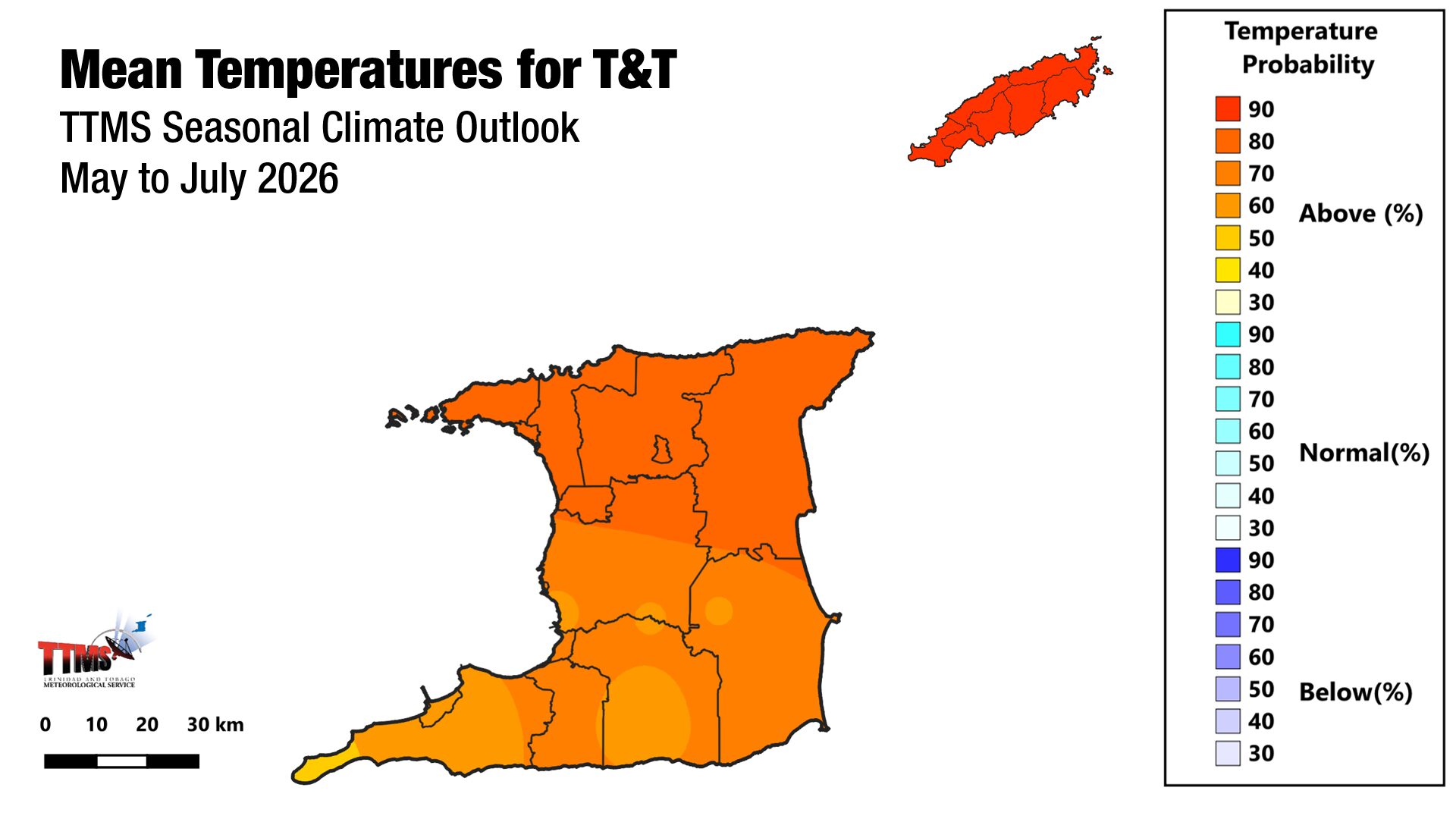
The TTMS’ MJJ 2026 outlook favors above-normal mean temperatures across both islands, with the strongest warm signal once again expected over urban and built-up areas where heat retention and reduced ventilation amplify warmth.
There is a moderate (64%) chance of warmer-than-average days in urban and built-up areas across Trinidad and Tobago. Cities and developed corridors are typically the first to feel the impact of regional warming trends.
A moderate chance (62%) also exists of short-duration hot spells during May to July, with maximum temperatures exceeding 34.0°C in Trinidad and 33.0°C in Tobago.
In Trinidad, a hot day is classified as a temperature above 34.0°C, while in Tobago, the threshold is 33.0°C. Prolonged hot days, known as hot spells or heat waves, can result in heat advisories, which the TTMS has issued in the past, including Hot Spell alerts, watches, and warnings. Based on historical issuance, these advisories are typically issued only if there is a risk of daytime temperatures exceeding 34.0°C and nighttime temperatures above 24.0°C on at least 3–5 days.
Urban Versus Rural
As is typical for Trinidad and Tobago, the strongest warm bias is concentrated over cities and built-up corridors. Conversely, rural areas of Trinidad and Tobago are more likely to experience cooler nighttime temperatures, although these are expected to be less frequent than during the Dry Season months.
What does this mean for you?
Higher-than-usual and extreme temperatures during May to July can amplify heat-related health risks, particularly for vulnerable persons and those with chronic conditions. Excessive heat can worsen respiratory illnesses, cardiovascular conditions, and heat-related illnesses, especially in densely populated and built-up areas.
The TTMS recommends that the health sector clear bushes, open drainage systems, fumigate in and around residences, and revisit contingency plans to manage spikes in vector-borne incidents and rainfall-related infections, given the warmer and intermittently wet conditions expected.
Increased heat may drive higher demand for cooling, straining the electrical grid and raising electricity costs for households and businesses.
In the agricultural sector, hot days and short-duration hot spells can cause heat stress in livestock and wilting in newly transplanted and younger crops. Aquatic farms may also be affected, as warmer-than-usual air temperatures can raise water temperatures, which is particularly important for aquaponic fish and plants. Water temperatures much warmer than 30.0°C can affect warm-water fishes such as tilapia.
For the general public, the TTMS advises proper preparation for at-risk persons, conservation and safe storage of water, and vigilance for bush, forest, and landfill fires.