


A strong magnitude 6.5 earthquake has struck east of the Leeward Islands based on preliminary information from the University of the West Indies Seismic Research Center (UWI SRC), which shaking reported from Puerto Rico to northern St. Vincent. As of 11:00 AM, there are no major reports of damage. In Antigua, there are reports of groceries falling off shelves.
According to the Pacific Tsunami Warning Center (PTWC), there is no significant tsunami threat to the Lesser Antilles.
There are four conditions necessary for an earthquake to cause a tsunami:
- The earthquake must occur beneath the ocean or cause material to slide within or into the ocean.
- The earthquake must be strong, with at least a magnitude of 6.5.
- The earthquake must rupture the Earth’s surface and occur at a shallow depth—less than 70 kilometers below the surface.
- The earthquake must cause vertical movement of the seafloor (up to several meters).
While based on the preliminary data, this earthquake just met the critiera, hence, the PTWC added “There may be a small possibility of tsunami waves along coast near the epicenter,” which would include Antigua and Barbuda, Montserrat and Guadeloupe.
Based on the UWI SRC, the quake was 80 km northeast of Saint John’s, Antigua and Barbuda, 80 km, 132 km northeast of Brades, Montserrat, and 132 km north-northeast of
Point-à-Pitre, Guadeloupe. It was at a depth of 31 kilometers.
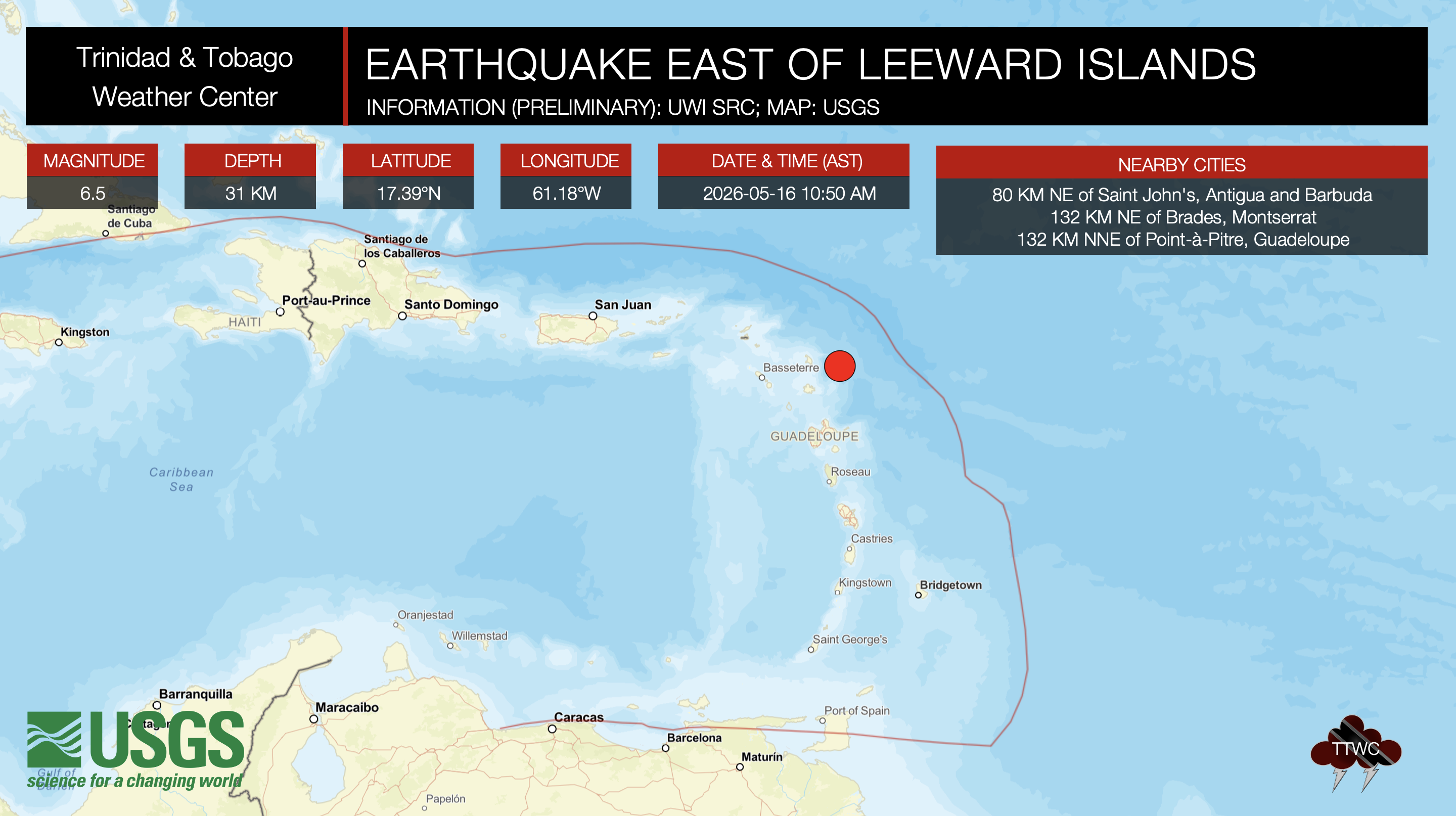
The UWI SRC, the authority on seismic and volcanological information in the English-speaking Eastern Caribbean, says this information is preliminary. You can submit felt reports to the University of the West Indies Seismic Research Center.
Note that different seismic monitoring agencies use different methods, or several methods, for processing quake parameters worldwide. Each method has its limitations and will likely produce different results within the range of the data’s uncertainty. This is generally accepted within the scientific community.
Read More

How did the Venezuelan Earthquakes Affect T&T?

Earthquake Magnitude & Intensity
On average, the Eastern Caribbean has seen a pattern of major (M7.0-M7.9) quakes every 20 to 30 years. That pattern has stayed true. The last major (M7.0-7.9) quake occurred north of Martinique in 2007.
Historical patterns indicate that great quakes (M8.0+) on the Richter Scale have occurred every century in the region. The probability of another event at that level is high since the last >M8.0 earthquake occurred in 1843. While it is impossible to say definitively when the next great quake will occur in the region, the time since the last one is now more than 170 years ago.
It is important to note seismic activity *cannot* be predicted – meaning the precise time, date, magnitude, depth, etc., cannot be known ahead of time based on current research and technology.
Now is the time to create or go over your earthquake preparedness plan and know what to do during, before, and after an earthquake.
Read More

In our region, earthquakes can strike at any time and any place, so it is important to know how to keep yourself safe when one strikes.


