


On Wednesday night, at 8:32 PM, skygazers across Trinidad and Tobago saw a meteor streak through the night sky, the second in less than a week.
The bright fireball was seen from central and southern Trinidad. Eyewitnesses reported that it moved west across the sky, with a yellow-orange tail, indicating an iron- or sodium-rich composition of the meteor. If you may have spotted a fireball or meteor, you can report it to the American Meteor Society, which collates such reports.
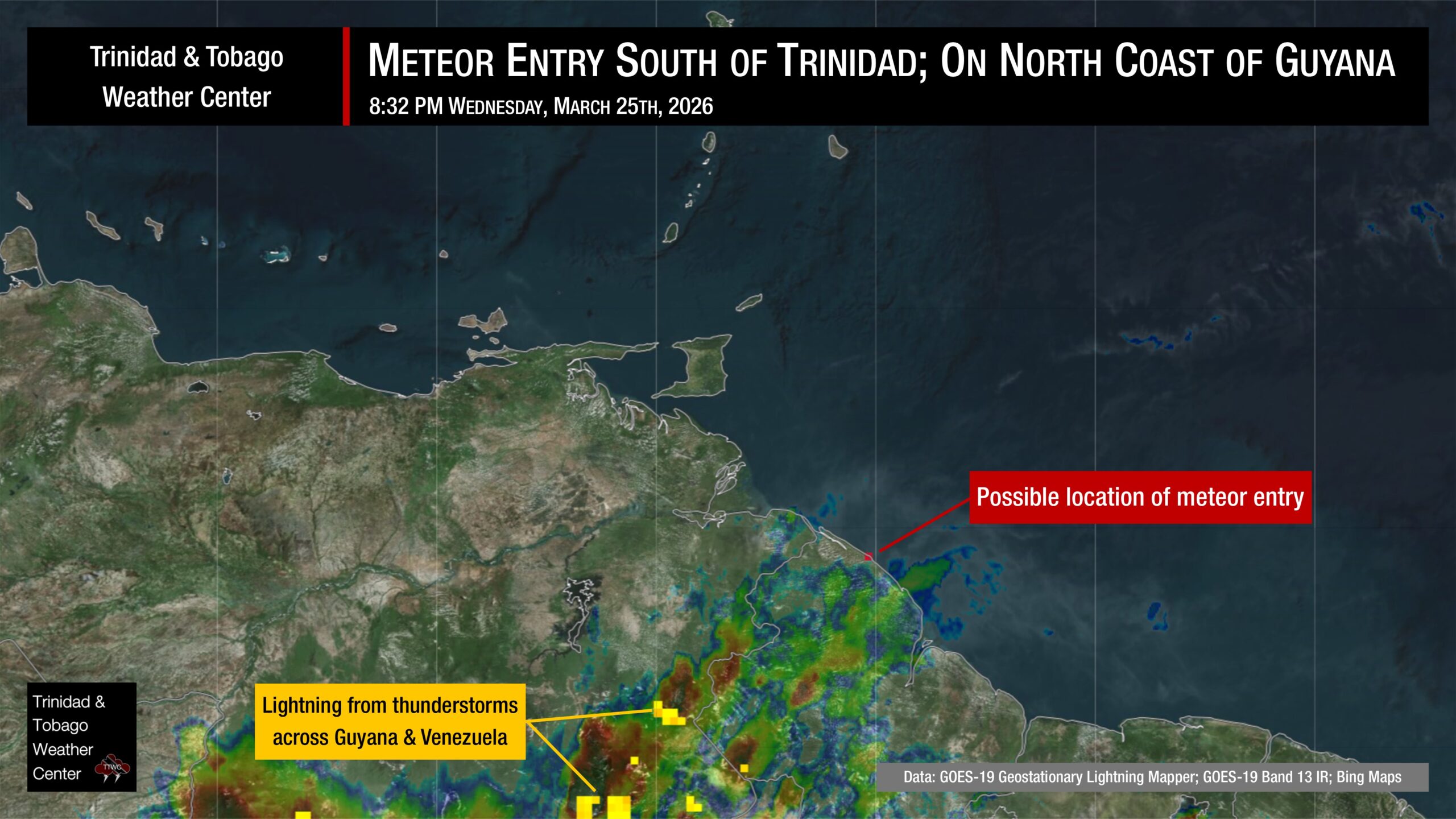
While no one was lucky enough to capture the meteor entry, the bright flash was picked up by the GOES-19 Geostationary Lightning Mapper (GLM), which detects bright flashes in the atmosphere. At 8:32 PM, the instrument detected a flash on Guyana’s north coast, approximately 320 kilometers southeast of Trinidad, where only upper-level clouds were present. To the south and east, lightning was also being detected from scattered thunderstorms.
This was the second meteor to be spotted in T&T’s skies over the past week. Early Saturday morning, Clayton Morgan spotted another meteor burning up in Trinidad’s western skies, as seen from Princes Town.
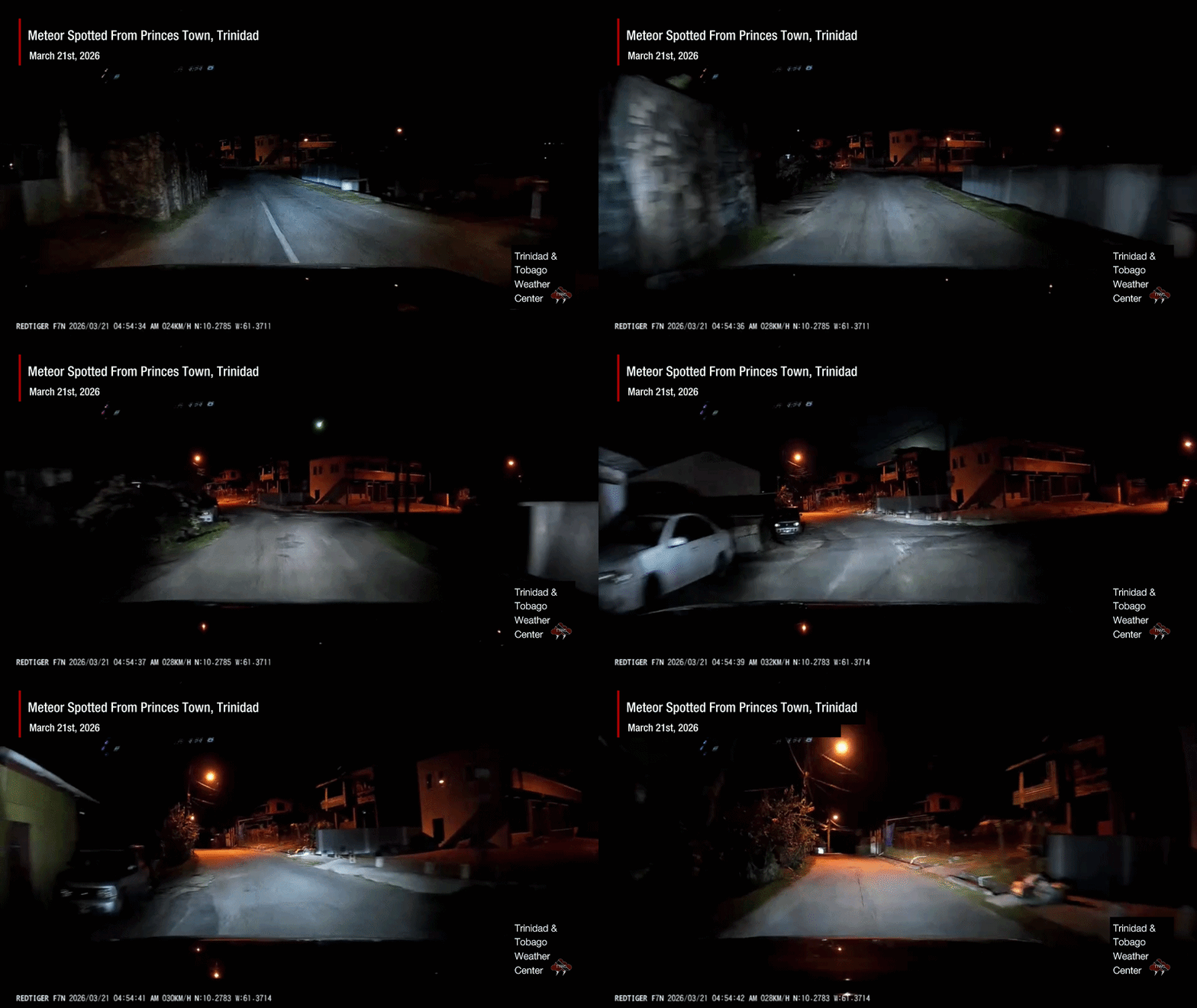
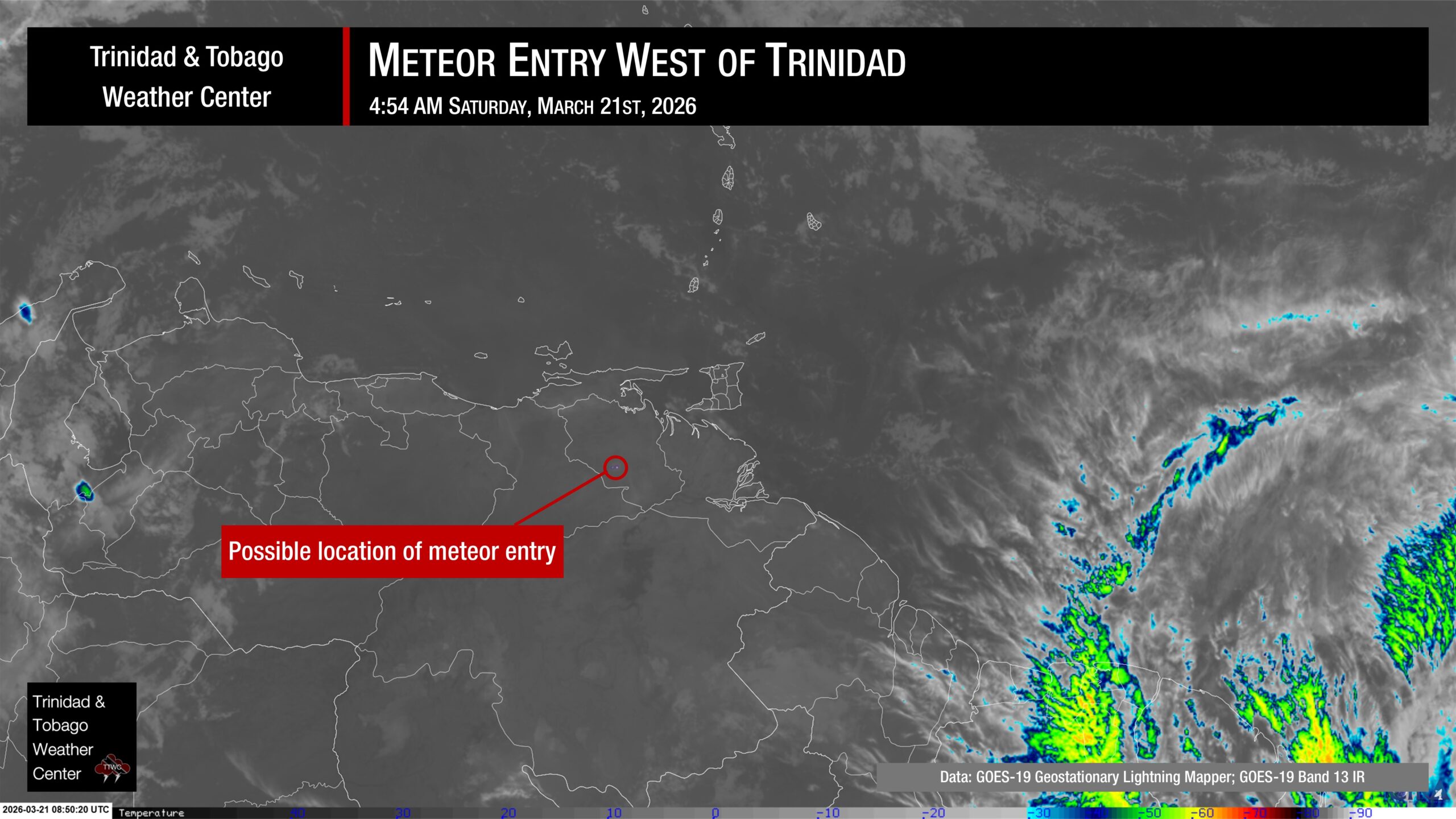
Based on GOES-19 Geostationary Lightning Mapper, this meteor burned up approximately 190 kilometers southwest of Trinidad, over Caratal de Tigre, Venezuela, at 4:54 AM March 21st, 2026.
Meteor sightings in Trinidad and Tobago aren’t unheard of and may be more common than one may think. Many go unreported or uncaptured, given their brief nature, illuminating the night skies. While we’ve received only two meteor sighting reports for 2026 to date, the American Meteor Society received 5 reports in 2025, 1 report in 2024, and 7 reports in 2023, including the particularly bright meteor on September 12th.
Read More

Meteor Burns Up Over Eastern Caribbean, Spotted In T&T

Meteor Burns Up In Sky West of Trinidad
A Meteor’s Glow
As meteors burn in the atmosphere, the colors of their glow and trails indicate their dominant chemical composition, with yellow trails indicating high iron content (most common) and orange trails indicating high sodium content.

What a meteor is made of is one of many factors that determine the color it appears to be. The speed at which the meteor enters the Earth’s atmosphere can also affect its color. The faster a meteor moves, the more intense the color may appear, according to the American Meteor Society. The Society also added that slow meteors are red or orange among fainter objects, while fast meteors are frequently blue.
Meteors generally begin to burn as they hit the Earth’s atmosphere, resulting in bright light emanating between 65 and 120 kilometers above the Earth’s surface. Meteors also dive into the atmosphere at speeds ranging from 40,200 to 257,500 kilometers per hour.
Where are these meteors coming from?
It is impossible to say where these meteors definitively originate, given the limited data we have. However, according to the American Meteor Society, several sources have been active over the past week.
- M2025-F1: Peak during March 18th through 23rd. Where to find: Puppis constellation. Meteor speed: 15 km/second (slow).
- nu Cygnids: Active March 22 through April 23, with maximum activity occurring near April 21. Where to find: southern Lyra, 5 degrees south of the 3rd magnitude star known as Sheliak (beta Lyrae). Expect 1 per hour, moving 44 km/second (medium speed).
- zeta Cygnids: Active from March 21 through May 1, with maximum activity occurring near April 6. Where to find: western Cygnus, 5 degrees west of the 2nd magnitude star known as Sadr (gamma Cygni). Expect 1 per hour, moving 44 km/second (medium speed)
All meteor showers evolve and disperse over time until they are no longer recognizable. Much more commonly, sporadic meteors make up the bulk of activity seen at night (away from peaks of major annual showers). These meteors can’t be associated with any meteor shower.
The next major celestial event is the Lyrid meteor shower, which occurs between April 16th and 25th. It’s expected to peak in the early morning hours of April 22, according to space.com.
How to tell meteors from space debris
Although some observers may think at first they are seeing a meteor, there are two main characteristics that will let you know if it’s space debris.
- Space debris appears as an extremely slow “meteor,” sometimes lasting one or two minutes. A natural meteor (space rock) takes just a few seconds to zip across the sky. In fact, space debris appears so slowly that some people can turn on their phone cameras to take photos or record video of the event.
- Another clear indication that the observed object is space debris in our atmosphere is that it will exhibit noticeable fragmentation. You’ll be able to see some small objects separating from the main object, with some leading to the main event while other fragments fall behind.
This is not the first time observers have seen Starlink satellites disintegrating in our region. On February 7, 2022, a group of just-launched satellites reentered the atmosphere when a geomagnetic storm from the sun prevented the satellites from reaching their intended orbit. Geomagnetic storms warm the atmosphere and increase atmospheric density, increasing drag and causing low-altitude satellites to reenter.
Meteors vs. Comets vs. Meteorites
While there were no reports of any space rocks hitting the ground over the past week, which would then be called meteorites, meteors frequently burn up worldwide, including in the Caribbean region. Colloquially called shooting stars, these meteor reentries peak during meteor showers, where the Earth passes through debris from comets, leading to these pieces of space rock or dust burning in the Earth’s atmosphere.
Meteorite strikes are more common than you might think. Dust-grain-sized meteoroids strike the Earth’s atmosphere almost constantly, but they often go unnoticed. Meteoroids between a millimeter and a centimeter burn up in the atmosphere and appear to us as shooting stars. Larger strikes are less common—a one-meter meteoroid strikes the Earth once each year on average and would reach the ground as smaller debris, while a 100-meter meteoroid strikes the Earth approximately every 10,000 years, according to a Tufts University fact sheet. Meteoroids over 1 kilometer in diameter hitting Earth are catastrophic events that occur, on average, every 1 million years.
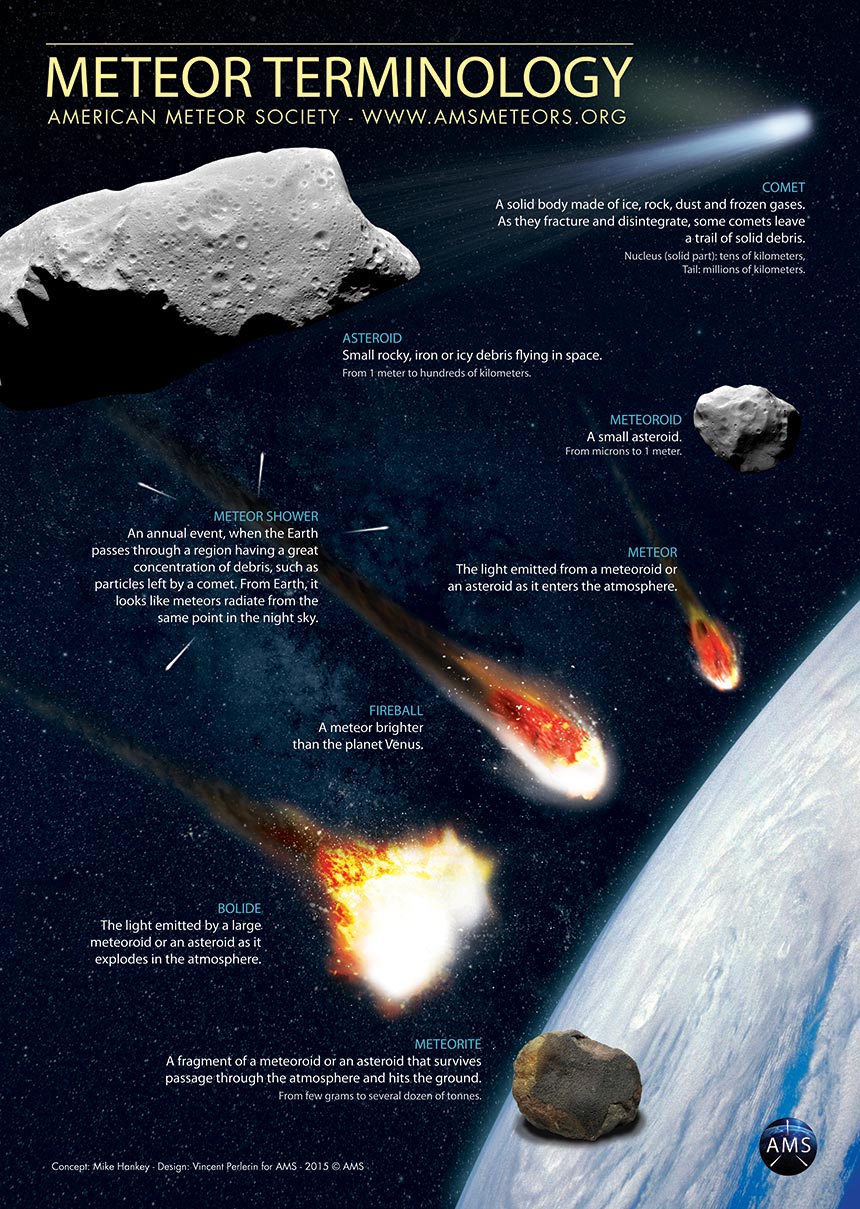
Meteoroids do not discriminate where they land or where they enter the Earth’s atmosphere. Hence, it is well within the realm of possibility that events like this could occur across Trinidad and Tobago or any of the other Caribbean islands.
But medium-sized strikes can be dramatic spectacles—and in some cases, dangerous. The Chelyabinsk meteor that struck southern Russia in February 2013 blew out windows and caused indirect injuries to almost 1,500 people.


